in which we discover the true importance of Rabbit’s Friends and Relations

Tide in or out? Time will tell. Photo by the author
The essay title is a quote from James Taylor, (“JT”), a beautiful songwriter and an icon of mine from carefree mid-teen days, in a Life article by Steve Rushin.1The article goes on to say JT “has come as close as any songwriter to divulging the meaning of existence.” although thankfully Rushin adds JT’s own caveat—beware the hubris of any man who claims to know what it’s all about. Rushin’s own verdict: “And yet, he isn’t wrong, is he?”
Enjoying the passage of time. Doesn’t sound like much and yet from my own experience, I can agree wholeheartedly that an ability to enjoy the passage of time is not only a good thing in itself but is also indicative of so much else that contributes to A Good Life. In the article, Rushin writes that introspection and addiction have been two sides of the same coin for JT. (Think “Fire and Rain”, a hauntingly memorable song about friendships in unexpected places.) He mentions JT’s periods of substance addiction and treatment in mental hospitals as a young man—which also resonates with a much older me. I don’t think the two sides of this coin are together by accident. True, some substances may have enhanced my perspective on life and time but it’s also true that my ability to enjoy the passage of time is one of the first things that my addiction to one of them in particular took away.
(If you need to hear the song again, like me, it’s here)
I’ve had good reason—and lots of time—to reflect on what life is, and what slows it down so I can enjoy its passing. Like doing anything slowly: gently holding hands with a lover on summer evenings whilst watching trout rising lazily in a lake. Or waiting for snow to melt. Letting leaf tea brew to perfection whilst baking bread. The grandfather clock in Nan’s pub had a measured tick that left me feeling time had almost stopped. Even in everyday life, noticing anything in detail—without talking about it—seems to expand time/s duration.
The grandfather clock in Nan’s pub had a measured tick that left me feeling time had almost stopped.
Of course, a few things slow time without being enjoyable: the vicar’s sermons when I was a child; playing who’s next in a doctors’ surgery waiting room, any visit to A&E. And very, very high speeds slow time, as I remember from reading chemistry at Uni, but since nobody actually experiences that, however factual it is, we can leave it out. I will say this though: someone caught in an addiction lives at very, very high speed; time becomes the gap to be endured between one fix and the next.
When, finally, I took my recovery seriously, the first thing I was shown was a way to count. One day at a time, then thirty, then a year. Counting makes sense, because all things pass, don’t they? Even “now” passes, though there is always another one in the next moment. Crises, thoughts, opportunities, seasons; childhood; life—all pass. And time, always, time itself passes.
In recovery, your tally of passed days measures your abstention, which means a thing has been removed from your life. My problem was that having something taken away from my life left a lot of time on my hands to fill.
In there, for me, was—and is—the crucial difference between abstention alone and the restoration of a life. Abstention was simple subtraction. Restoration was about putting things back, and the things that make life better are on a list you can’t get on prescription, let alone at the wrong end of a bottle of Smirnoff. Things like real mental and physical health; the company of good friends; spontaneous laughter; an income of twenty shillings and sixpence with expenditure of sixpence less (adjusted for inflation); pain-free teeth; almost all dogs and some cats; sunny days and winter snow; a fire in a hearth. And love. Lots of it, starting with unconditional love for yourself. Myself.
What I realised was that none of these can be obtained and sustained if you’re alone.
It would be easy to frame this as antipathetic to Alcoholics Anonymous, with its focus on abstention and unseen powers. Abstention was very necessary for me in the early days of recovery but I can tell you what I found was the real power in those meetings: the sense of belonging, of being unconditionally accepted. By people I could see, talk with, listen to. AA calls itself a fellowship. A 2020 Cochrane review found that AA and twelve-step facilitation programmes performed at least as well as other established treatments at keeping people abstinent. My suggestion, and it is a suggestion, is that the AA rooms work because they supply those missing items: the same faces on the same evening, a cup of tea, a person who will pick up the phone. AA got me to a place where I could begin to be human again.
The rest of my journey has been to find my community, to build relationships, to have that sense of belonging beyond it being defined by an abstention from something. In a nutshell, I found friends.
When I was reading about JT, my eye was caught by a piece on “Friendship Therapy” by Jamie Ducharme.2 That must fit in here somewhere, I thought, and indeed it does. Friendships and relationships are on my list of things worth doing well, alongside loving, cooking, being alive, writing, giving, noticing, parenting, asking and listening. Notice, if you will, that loving, giving, parenting, asking and listening are verbs that ask for another person on the other end. You can’t do them alone.
It turns out that people are paying professionals to repair their friendships and Ducharme reports that friendship therapy, once “somewhat fringe”, is growing in popularity as people realise that friendship is “intimately connected to well-being and happiness,” and that, particularly after the pandemic, “many people don’t have as many strong connections as they’d like.”
There is a further reason to take the business of relationships with those around us seriously. Let me say up front that this is, so far, a growing analogy in my writing eye, forming the spine of the book I’m working on. As an analogy it doesn’t bear detailed inspection—please bear that in mind. The biologist Dr. Michael Levin studies how cells cooperate through electrical signals to achieve goals of building and repairing bodies. We know that nearly every cell in a given organism contains the same DNA as all other cells; it seems that in a healthy system, cells can “agree” to be a part of Team Liver, for example, and forgo their potential to be a retinal cell or a bit of heart muscle.
What matters is alignment
Levin & Co have shown how changing the electrical pattern shared among cells can change the shape and/or function the tissue grows into. He and his colleagues have also proposed that cancer can be considered as a problem of a breakdown in cellular connections. A cell that loses its electrical connection to its neighbours reverts to the concerns of a single cell, and starts behaving like one. Growth at all costs, even its own eventual demise. Sound familiar? At the height of my addiction, my life scope was narrowed to the size of the next dose. Extreme self-ness. Or maybe cell-ness. Restoration of connectivity widened it again, and I suspect this is true on the scale of cells, organs, body and mind, and beyond them to a household, a village, a fellowship. What matters is alignment; parts that are aligned create something none of them can alone. A cell on its own proves little about a lonely man. But it feels like the right shape for my story of what it is to be human.
What’s any of this to do with Rabbit’s Friends and Relations and the Hundred Acre Wood? I happen to believe that not much can beat a little something with a friend at just the right time each day, as Pooh would say. Or whatever your version of having friends is. Rabbit, in Milne’s stories, has more friends and relations than he can keep track of, but he keeps trying to organise them anyway, which is a pretty good description of human community and better than most sociology. They are small, numerous and a tad exhausting. They also turn up, especially when needed even if, like Pooh and Piglet, they occasionally mistake your house for a pile of sticks.
So I’m with JT. The secret of life is enjoying the passage of time. It turns out that this is tough to do on my own, and easy to do on a walk, over proper tea, with bread, in front of a fire, a dog by my side (I’ll even accept a cat deciding whether to sit on my lap), among friends and relations. Time passes. Friends and relations help me to enjoy it.
The End.
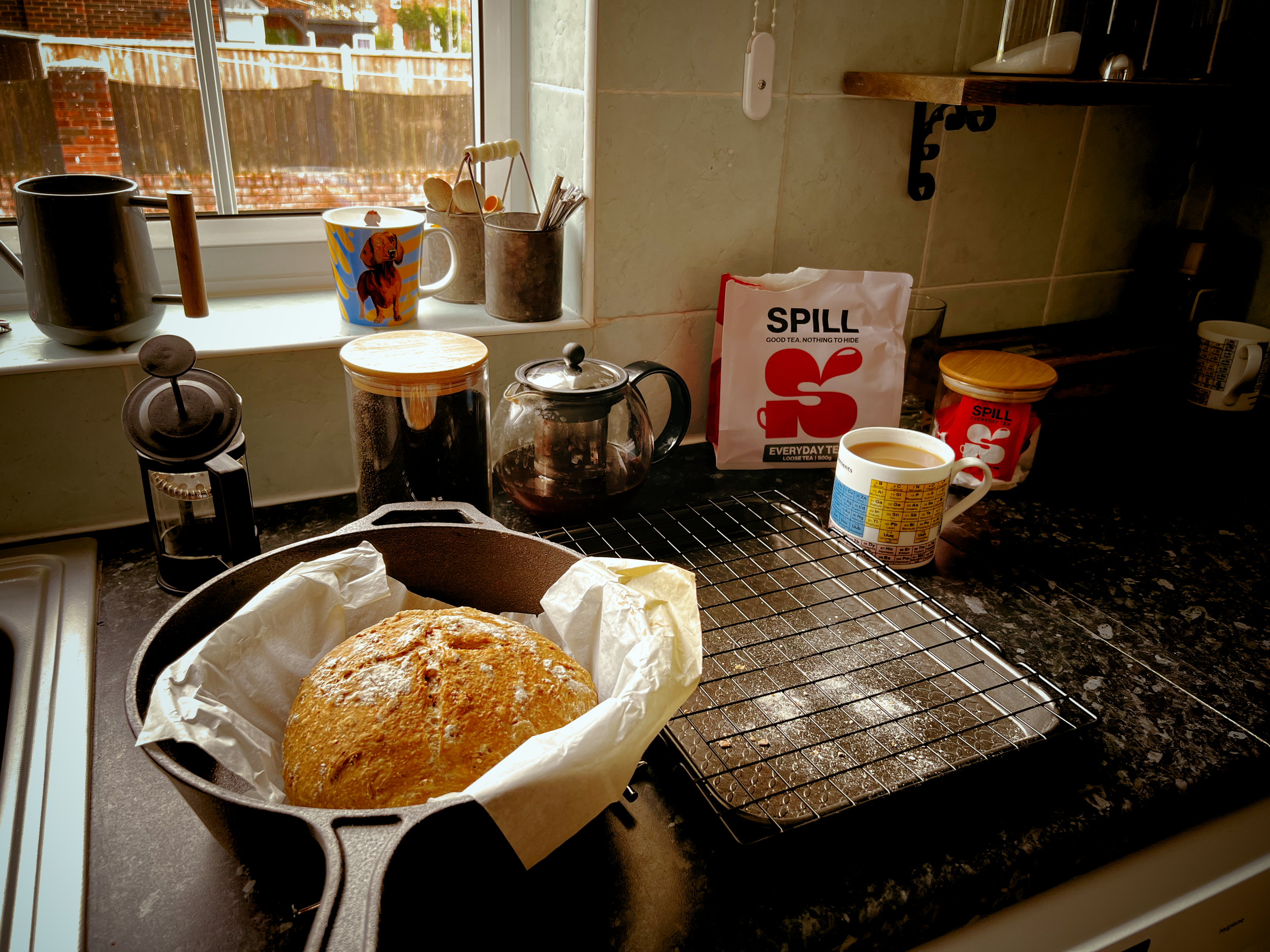
Worth doing well - and slowly. Serves 2, maybe more
1 “James Taylor at 75” https://www.life.com/arts-entertainment/james-taylor-the-songwriter-at-75/
2 “What is Friendship Therapy?” https://time.com/7014493/what-is-friendship-therapy/